Every pursuit, one board.
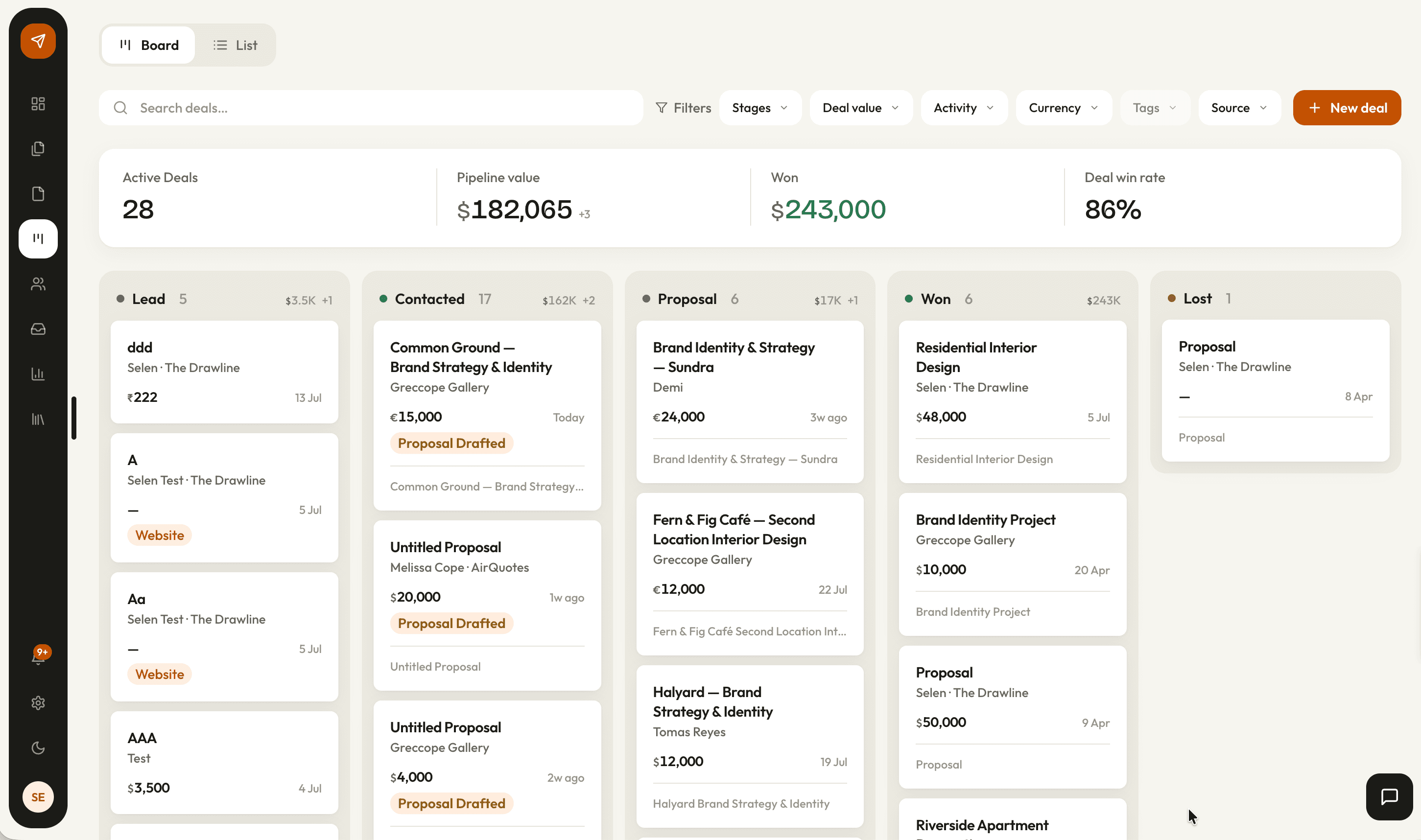
A kanban board and list view hold every deal from first contact to won or lost. Drag a card between stages and the deal record updates.
How it works
A deal arrives
From the enquiry form on your website, or added by hand after a call. Either way it lands as a deal with the source recorded.
Move it across the board
Five stages: lead, contacted, proposal sent, won, lost. Drag a card and the deal record updates.
Send a proposal from the deal
Sending from AirQuotes advances the deal to proposal sent for you, so the board does not go stale the moment you get busy.
Read the totals
The stats bar carries open value, win rate and counts by stage, so the board doubles as the answer to how much work is actually in play.
Five stages, and what they mean
A pipeline with fourteen stages is a pipeline nobody updates. These five map to the decisions a studio actually makes about a piece of work.
- Lead, contacted and proposal sent are the open stages, and the ones that carry forecast value
- Won and lost are decided; a lost deal records why
- Sending a proposal advances the deal without anyone remembering to
- Signing marks the contact as a client rather than a lead
- Lead6£54k
- Contacted4£71k
- Proposal sent3£96k
- Won2£42k
- Lost1£18k
Board or list, filtered either way
The kanban is right when you are deciding what to chase this week. A list is right when you are looking for one deal among ninety. Both are views of the same data.
- Filter by stage, by source, by owner and by currency
- Search across deals and switch between board and list without losing the filter
- Contacts carry a status of their own: lead, client, past client, partner, subscriber or archived
- Multi-contact companies, so the person who signs and the person who briefs are both on the record
- ✓Stage: proposal sent
- ✓Source: website form
- ✓Currency: GBP
- Owner: anyone
Forecasting you can defend
A total across stages is only useful if the numbers under it came from somewhere. Every value on the board is the fee on a real proposal or the figure you entered on the deal.
- Open value totalled by stage rather than one blended number
- Deal win rate, which counts deals and will differ from the proposal win rate in Analytics
- Values kept in their own currency rather than converted behind your back
- Won revenue carried through to the analytics view
- Price5
- Timing3
- Went in-house2
- No response2
Against a spreadsheet
| What changes | Spreadsheet | AirQuotes |
|---|---|---|
| Getting a deal in | Typed in, when you remember | Created by the enquiry form, or added by hand |
| Stage changes | A cell you forget to edit | Drag the card; sending a proposal advances it for you |
| Deal value | Typed twice, once in the sheet and once in the proposal | The fee on the proposal |
| Mixed currencies | Converted by hand, or ignored | Held and totalled per currency |
| Why you lost | Rarely recorded | A reason on the deal, feeding the loss breakdown |
| Finding one deal | Scroll, or filter badly | Search plus filters on stage, source, owner and currency |
Scroll the table sideways for the AirQuotes column.
What it does not do
It is not a full CRM
Deals, contacts, companies and the proposals attached to them. No sequences, no lead scoring, no email sync. If you need those, this is the wrong tool to make do with.
It does not chase for you
The board will show you a deal that has not moved in three weeks. Nothing here sends the follow-up, and automating that email is usually a worse idea than writing it.
Forecasts are only as good as the entry
A deal with no value on it counts as zero. A board half-updated is worse than an honest spreadsheet, because it looks authoritative.
Two win rates, on purpose
The pipeline counts deals and Analytics counts proposals. They will not match, because one deal can carry more than one proposal.
Asked before you ask
What are the stages?
Lead, contacted, proposal sent, won and lost. The first three are treated as open and carry the forecast value; won and lost are decided outcomes.
Does sending a proposal move the deal?
Yes. Sending from AirQuotes advances the deal to proposal sent, so the board reflects what you did without a second step.
How are different currencies handled?
Values stay in the currency they were quoted in and are totalled per currency rather than converted at a rate nobody agreed to. Currency is also one of the filters.
Why does the win rate differ from the one in Analytics?
The pipeline counts deals; Analytics counts proposals. A deal that took three proposals to close is one won deal and three proposals, so the two figures answer different questions.
Can I record why a deal was lost?
Yes, and the reasons are your studio’s own rather than a fixed list. They feed the loss breakdown in Analytics, which is where the pattern shows up.
See it on your next proposal.
Beta access is free for two months on the Studio plan. Applications are reviewed manually, and approved studios build their first proposal from their own brief.
Apply for beta →